
Table of Contents
1. What is a Progressive Web App and Why Does it Matter in 2026?
A Progressive Web App (PWA) is a website built with modern web technologies that behaves like a native mobile application. It can be installed on a home screen, works fully offline via service workers, sends push notifications, and loads in under a second from cache — all without requiring an App Store submission.
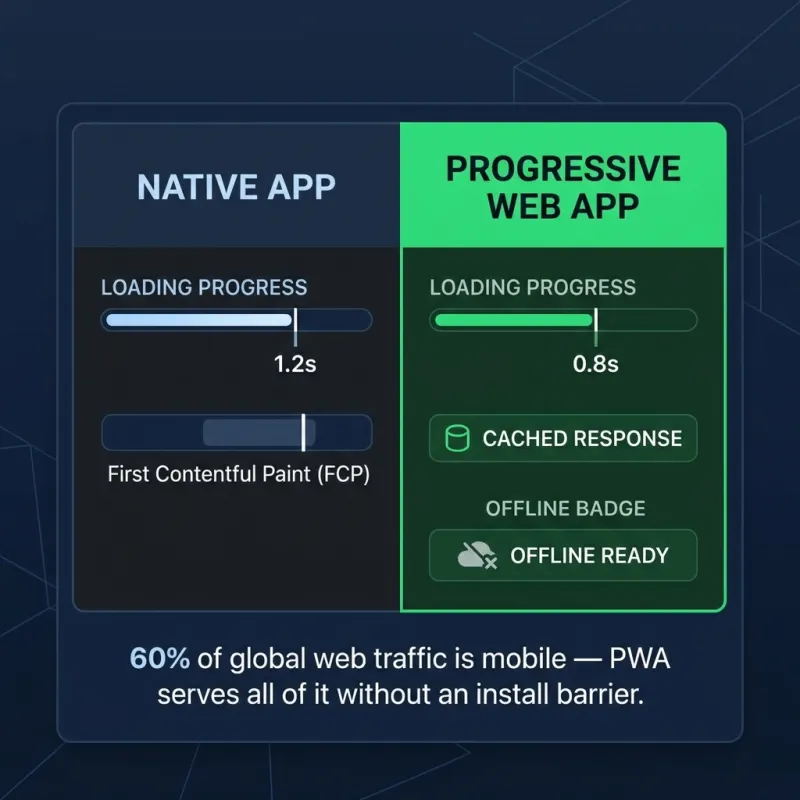
With mobile devices accounting for 60% of all global web traffic, the stakes for mobile-first delivery have never been higher. The PWA market is growing at a CAGR of over 30% through 2035, driven by businesses demanding app-like experiences without the maintenance overhead of two separate native codebases.
2. The True Cost Comparison: PWA vs. Native
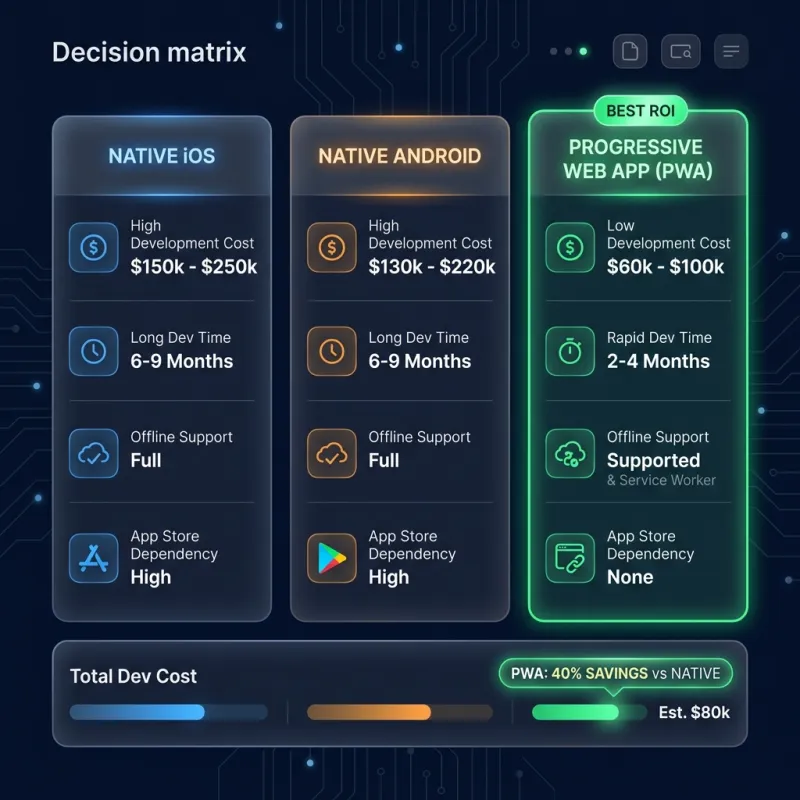
Building a native iOS app and a separate native Android app effectively doubles your development investment and your ongoing maintenance burden. A single PWA codebase, by contrast, serves every platform simultaneously — iOS, Android, desktop, and smart TVs — from one deployable unit.
For most product teams, this translates to approximately 30–40% reduction in total development cost. When you factor in App Store review cycles (which average 1–3 days for iOS), annual developer programme fees ($99/year Apple, $25 one-time Google), and the ongoing cost of maintaining platform-specific codebases through OS updates, the TCO advantage of PWAs becomes significant over a 3-year horizon.
3. Performance: How Close is a PWA to Native?
The performance gap has closed dramatically. Modern PWAs using the Workbox library for service worker management, paired with a CDN-delivered shell architecture, can achieve sub-800ms interactive load times from cache. For the user, this is functionally indistinguishable from a native app launch.
Where native still wins: hardware-intensive applications (AR, Bluetooth, NFC, complex gaming), applications requiring deep OS integration (health sensors, payments via Apple Pay biometrics), and apps where the App Store discovery channel is a core acquisition strategy. If none of these apply to your business, a PWA is the superior investment.
4. The ROI Decision: When to Build Which
Use this framework: if your primary acquisition channel is organic web traffic or social media, build a PWA. If your product is a marketplace or utility where App Store presence is a trust signal, build native. If you need to validate a product idea with minimal investment before committing to native development, build a PWA first and migrate only if you exceed a measurable engagement threshold.
Need help evaluating the right architecture for your product? Our custom website development team can provide a free technical assessment. You may also find our guide on cross-platform development helpful for understanding your options.
Transform your business today.
Reach out to our experts and discover how custom software can accelerate your growth.


